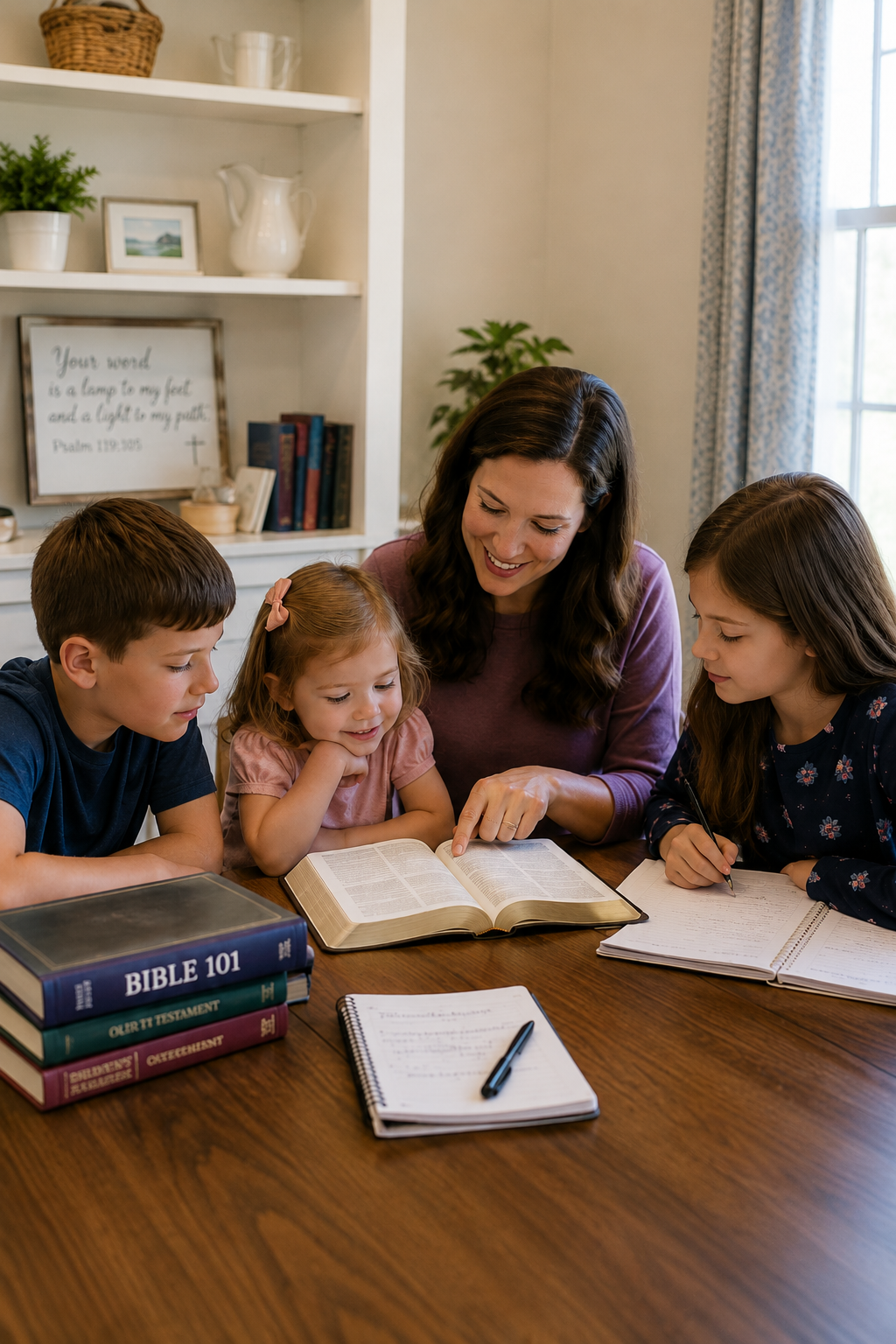
Homeschool Bible Class: How to Not Overcomplicate It
Bible study often gets missed during the homeschool day. It’s understandable: children may already be learning the Bible at church or Sunday school, while other subjects quickly fill the school day. Here are some practical tips to keep Bible study from becoming the one subject you always mean to get to but never do.
1. Choose the Best Time of Day for Bible Study
The best time for Bible study is the time your family can follow consistently. For some families, that may be first thing in the morning before other subjects begin. Others may find that Bible fits better after breakfast, during lunch, or near the end of the school day. The exact time matters less than choosing a regular place for it in your schedule. If Bible study is always left for “whenever we have time,” it will usually be the first thing skipped. Treat it like a real part of the homeschool day by deciding ahead of time when it will happen.
2. Know How Much Time Different Ages Realistically Need
Bible study does not have to take a long time to be meaningful. Young children may only be able to listen and participate for five to ten minutes, while older children and teens can usually handle a longer lesson with reading, discussion, and written work. It is better to plan a short Bible time that your children can do consistently than to create a long lesson that becomes frustrating or gets skipped. As they grow in attention and understanding, you can gradually increase the time.
3. Make Bible Study Work When Your Children Are Different Ages
If you have both older and younger children, they can often study the same part of the Bible at the same time. The younger children may hear a simplified version of the story and answer basic questions, while the older children read more of the passage, discuss its meaning, and make deeper connections. Because everyone is learning the same section of Scripture, older children may even be able to help retell the story or explain it to their younger siblings. This can reinforce what the older children are learning while allowing the whole family to grow together.
4. Understand the Difference Between Family Devotions and Bible Instruction
Family devotions and Bible instruction are both valuable, but they serve different purposes. Family devotions are usually shorter and focus on worship, prayer, encouragement, or applying one truth to daily life. Bible instruction is more intentional and systematic. It helps children understand the people, events, themes, and structure of Scripture so they can see how the whole Bible fits together. A family may do both, but one does not necessarily replace the other. Devotions help children respond to God’s Word, while Bible instruction helps them understand it.
5. Decide Whether Bible Should Be Treated as a School Subject
There is nothing wrong with treating Bible as a real school subject. In fact, giving it a regular place in your homeschool schedule can help keep it from being pushed aside. That does not mean Bible study has to feel dry or overly academic, but it can include clear lessons, reading assignments, discussion questions, memory work, and age-appropriate activities. Treating Bible seriously communicates that understanding Scripture is just as important as learning math, history, or science.
6. Teach the Bible Even When You Do Not Feel Knowledgeable
You do not need to be a Bible scholar to teach your children Scripture. Whether your child is six or sixteen, you can learn the Bible together. Be honest when you do not know an answer, and investigate it together. In fact, letting your children see you study, ask questions, and continue learning can be a valuable example. You are teaching them that studying Scripture is a lifelong journey—and a lifelong joy.
Ready to Make Bible a Consistent Part of Your Homeschool?
You do not have to figure out what to teach or how the whole Bible fits together on your own. Bible 101 gives students (and parents) a clear, structured overview of Scripture so they can understand the people, events, and themes that connect the Bible from Genesis to Revelation.
The course is self-paced and designed to make Bible study easier to include in your homeschool without adding hours of preparation for you.